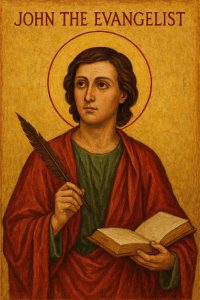
 Who is the beloved apostle? It is no hidden fact that he is one of the two sons of Zebedee and Salome, the woman who requested that her two sons be with Jesus at either side (cf. Mt 20:20–21) and was also at the foot of the cross (cf. Mt 27:56). All indications from the Gospel point to John, the brother of James, who was among the first disciples called by Jesus (cf. John 1:35–40). But what makes him the beloved apostle? In most societies, some people born under certain circumstances are usually cherished and given preferential treatment, this often makes them beloved. Could this be said about the apostle John?
John was the only apostle to have died a natural death, maybe as a fulfillment of the prophecy of Jesus in John 21:20, as against all the other apostles who died in martyrdom. This is why white is used on the feast of St. John the Apostle in the liturgical calendar and celebration, unlike for the other apostles. John was also among the few disciples of Jesus in the New Testament blessed with the gift of vision, evident in his apocalyptic writings characterized by visions of the end time.
John’s own writings betray him as the beloved apostle, though he never mentioned his name. Scholars say he was the youngest of the twelve, probably around seventeen or eighteen years of age when he met Jesus. Evidently, all the apostles were younger except Peter, whom scriptures attest had a wife. From Matthew’s account of the temple tax, it is noted that Jesus told Peter to cast a hook in the sea and pay the tax for Him (Jesus) and Peter (cf. Mt 17:24ff). Why not the others? This could mean the other disciples were below the age of paying tax except Peter.
In the Catholic Stations of the Cross, the fourth station denotes that Jesus meets His sorrowful mother. Some Biblical scholars say His disciples had either deserted Him or ran away to avoid being crucified with their master, but Mary, the only sinless one, stood there. John was probably around from a distance though not mentioned. Taking a clue from the trial of Jesus at the courtyard of Annas the high priest, the unidentified disciple who led Peter into the courtyard was John, son of Zebedee. Some dispute this, arguing that an uneducated fisherman from Galilee could not have earned such honour. But considering that at the call of John and his brother James, they left their father and the hired servants (Mk 1:19–20), this predicts that Zebedee could possibly be a wealthy man because not everyone could afford hired servants at that time unless rich, and this probably earned John that honour since the rich then related with class. Not forgetting also that the rich in Jesus’ time sought prestige and honour from influential people, and as such the sons of Zebedee, realising this and their quest for honour, sought favour from Jesus—hence their request in Mark 10:35–45 and that of their mother in Matthew 20:20–28. These analogies had probably given that privilege to relate with the high priest, though some people may claim Nicodemus as the one, forgetting that he was a secret disciple and would not have risked being identified as that unidentified disciple. John’s quest and his recipient of Jesus’ love could be the underlying factor that pushed him to follow Jesus into the courtyard and even seek permission for Peter, who is closely associated with the beloved apostle, taking a clue from the transfiguration, the preparation for the Last Supper, and the quest to know the betrayer.
At the foot of the cross, he was the only disciple there. John again referred to himself as such: “when Jesus saw his mother and the disciple whom he loved…” (John 19:26, African Bible). Scholars admit that John was the caretaker of Mary until her mandate on earth was accomplished. Therefore, the affirmation that John was that beloved apostle of the Lord, and this scene is depicted on the San Damiano cross.
Another instance that shows that John is evidently the beloved apostle is the moment of the resurrection at the Sea of Tiberias in John 21. One can attest that it is only a person with an intimate relationship who can easily identify him or her, and this is exactly what played out in verse 7. He easily identified Jesus. And the response of Jesus to Peter in verse 22 depicts Jesus’ immense love for John, who had been around Him throughout His ministerial duty, and verse 24 proves that John wrote the Johannine Gospel and attests to the fact that he is the beloved disciple of the Lord and, to appreciate this love, stayed around His earthly ministry and cared for His mother.
John the Evangelist: Apostle, Beloved Disciple, and Visionary
January 21, 2026 · 1 response
SHARE
RESPONSES
Reply to this piece
The Observer is a home for quiet conversation. Share a reflection, a poem, or a thought of your own.
Nice… I have now gotten it