By: The Observer
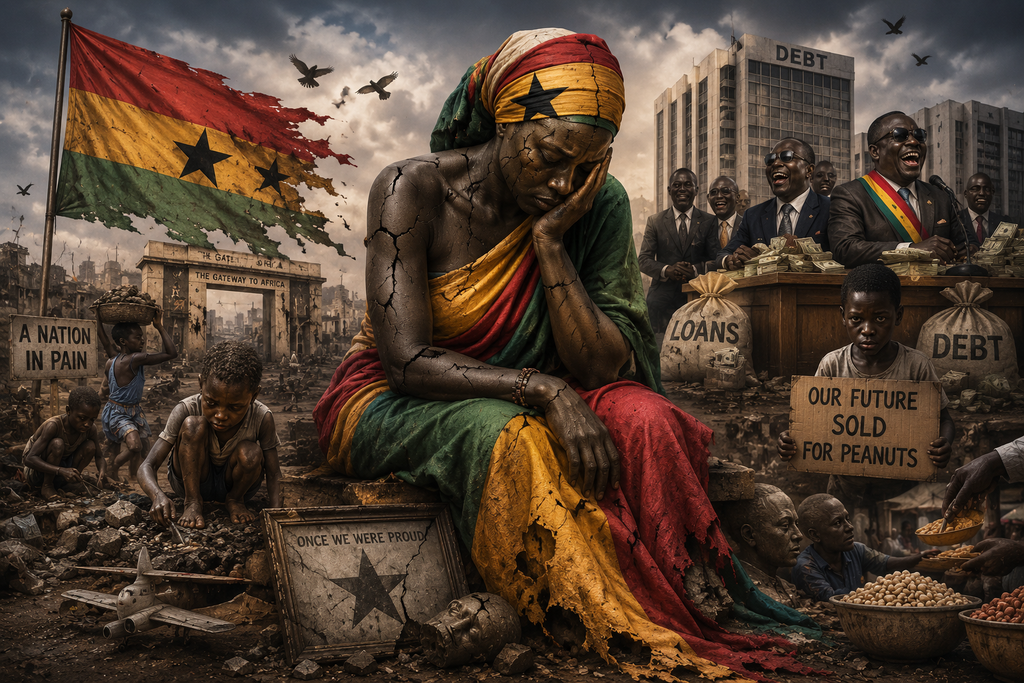
She who once blazed as the Black Star of Africa
Has now sunk into a den of robbers.
The gateway to Africa has closed in.
A deathway where dreams break down and fall apart.
A nation that once stood tall among her peers
Now slips away like valleys hidden beneath the Himalayas.
Her children work their fingers to the bone for bread.
Yet they only pick up the crumbs—crumbs that drop off the tables of the mighty.
Her pursuers rise like palm trees by running streams.
While she scrapes by, licking the surpluses of their abundance.
A cradle that once brought forth innovation and intellect
Has turned into a breeding ground for mediocrity.
Her children have grown into stomach politicians.
Selling out their future and passing down debts
That weigh heavily on generations yet unborn.
She cast off her son,
Handed him over to hoodlums to beat down and brutalize.
Sold her children for a day’s wage,
And now sits back with hands clasped between her thighs.
She trades away her jewels for peanuts.
Jewels that never pay off for her remaining children,
But only line the pockets of those who have thrown away their conscience for chicken change.
Once she held her head high, but now she has let herself down.
Giving away her pride and watching her glory fade out of sight.
Her children cry out, but their voices are drowned out by the noise of greed.
Her treasures are pawned off.
Her dignity chipped away.
Her hope sold out to the lowest bidder.
Yet somewhere deep within her broken soul,
A spark still flickers—
A reminder that stars, though dimmed, can blaze up again when the night is darkest.
Theme of Lost Glory
The poem begins by reflecting on the nation’s illustrious past, symbolized as the “Black Star of Africa,” a title evoking pride, leadership, and the promise of a prosperous future. This image represents a time when the nation was a beacon of hope and strength, admired both internally and externally. However, the poem starkly contrasts this former brilliance with the present reality, where the nation has deteriorated into a “deathway where dreams collapse.” This transformation from a proud gateway to a place of despair highlights the tragedy of lost potential and forgotten greatness.
Exploitation and Inequality
One of the most poignant themes is the deep inequality that pervades the nation. The poem vividly paints the daily struggle of ordinary citizens, especially children, who “toil for bread” but are forced to survive on mere “crumbs.” This image powerfully conveys the exploitation of the vulnerable, who labor hard yet receive barely enough to sustain themselves. Meanwhile, the wealthy and powerful “flourish like palm trees by running streams,” enjoying abundant resources and comfort. This sharp contrast emphasizes the unjust distribution of wealth and opportunities, revealing a society where privilege thrives at the expense of the masses.
Corruption and Failed Leadership
The poem harshly criticizes the nation’s leadership, depicted as “stomach politicians” whose primary motivation is greed rather than the welfare of their people. These leaders are described as shortsighted and self-serving, “leaving debts for their grandchildren,” implying that their mismanagement will burden future generations. The metaphor of selling national jewels “for peanuts” signifies the reckless disposal of valuable resources for trivial personal gain. The phrase “sold their conscience for chicken change” suggests a complete moral collapse among those in power, who have abandoned integrity for insignificant rewards. This corruption erodes the foundation of the nation, undermining trust and progress.
Betrayal of the People
The poem conveys a profound sense of betrayal, with the nation itself depicted as having “despised her son” and “sold her children for a day’s wage.” This imagery suggests that the leaders and those in authority have forsaken their responsibilities, sacrificing the hopes and futures of the youth for immediate, short-term benefits. The metaphor extends beyond economic exploitation to a deeper social and emotional abandonment. It reflects a broken relationship between the state and its citizens, where loyalty and care have given way to neglect and opportunism.
Moral and Spiritual Collapse
Beyond political and economic decline, the poem reveals a deeper, more intimate loss: the nation’s dignity and moral compass. The image of the nation “sitting with hands clasped between her thighs” evokes shame, helplessness, and vulnerability. It suggests a collective spirit stripped of pride, watching helplessly as corruption and decay consume its soul. This spiritual collapse is perhaps the most tragic aspect of the poem, signifying not just external ruin but an internal erosion of values and hope.
Core Idea
At its essence, the poem serves as both a lament and a warning. It mourns the fall of a once-great nation, celebrated as a symbol of leadership and promise. It condemns the forces of corruption, exploitation, and betrayal that have brought about this downfall. Moreover, it highlights the generational impact of failed leadership, showing how the consequences of today’s greed and shortsightedness will haunt the children yet to come. Ultimately, the poem is a call for reflection—a powerful reminder that greatness is fragile, easily lost when conscience is sold cheaply, and that the true measure of a nation’s decline is found in the suffering of its people.
Hmm it is well.