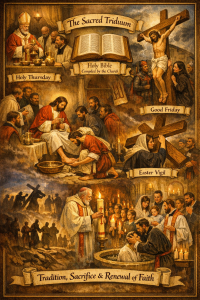
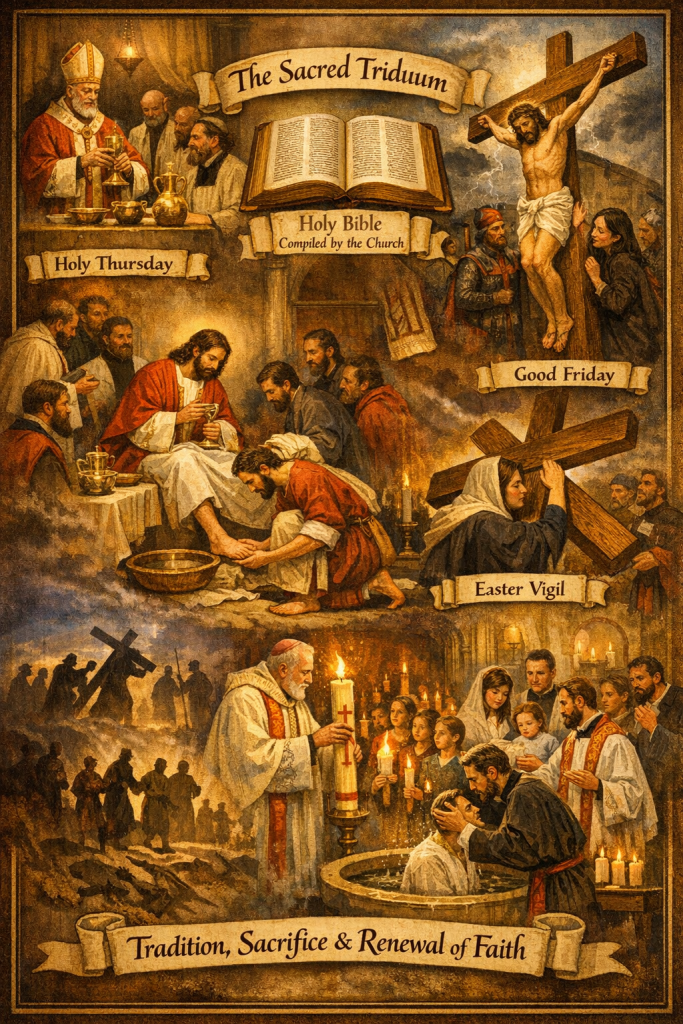
 Every year, the Catholic Church enters into a sacred marathon of rituals, the Triduum. For outsiders, the word “ritual” often carries suspicion, even ridicule. Critics dismiss them as outdated or mysterious, forgetting that these practices have carried the Church through centuries. Yet for those who live them, these rituals are not relics of superstition but living traditions that embody service, sacrifice, and hope.
It is almost comical when detractors accuse the Catholic Church of “adding books” to the Bible. Few realize that the Church itself compiled the Scriptures they now hold dear. To borrow from the original compiler and then claim ownership of the “true” version is, at best, ironic.
The Triduum begins on Holy Thursday morning with the Chrism Mass, a celebration of priestly unity and the sacredness of the priesthood. Later that evening, the Mass of the Lord’s Supper ushers in the Eucharist; the summit of Catholic faith. The washing of feet, echoing Christ’s humility, is a striking reminder that leadership in the Church is rooted in service.
On Good Friday, the tone shifts to solemnity. The Stations of the Cross, whether dramatised or sung, invite believers to walk alongside Christ to Golgotha. The intensity of this ritual often moves worshippers to tears. At its heart lies the Veneration of the Cross, a practice dating back to the earliest Christians who honoured the wood on which Christ died.
Then comes the Easter Vigil, a breathtaking liturgy that begins in darkness. As candles are lit and carried into the chapel, the glow spreads, symbolising Christ’s triumph over death. The Liturgy of Light is more than spectacle, it is a story told in flame: that at the end of every tunnel, there is light.
The Vigil often culminates in the Sacrament of Baptism, the rebirth into life in Christ. This moment of renewal is not just personal, it is communal, a reminder that faith is passed on, generation after generation.
The Catholic Church is indeed full of rituals. But far from being empty gestures, they are threads woven through history, binding believers to Christ and to one another. They are the heartbeat of a faith that has endured criticism, misunderstanding, and change, yet continues to shine with meaning.
Rituals of Faith: The Enduring Beauty of Catholic Triduum
April 14, 2026 · No responses yet
SHARE
RESPONSES
Reply to this piece
The Observer is a home for quiet conversation. Share a reflection, a poem, or a thought of your own.