By: SKIMS
 Implications of Man as Superior
The quote, “Of all things the measure is Man, of the things that are, that they are, and of the things that are not, that they are not,” by the Ancient Greek sophist Protagoras, has often been linked to moral relativism. However, it can also be viewed optimistically as affirming that humans are endowed with a unique responsibility within the order of things. Since the beginning of time, humanity has used its advantage as the only rational being to explore reality in pursuit of survival. This exploration has yielded remarkable achievements, and the evidence suggests humans are willing to go further—transcending personal limits in pursuit of higher ideals. Because in the natural order, there must be a head (“kephale” in Greek), man, with the highest level of rationality, becomes that being. This makes humanity the only creature capable of moral responsibility. As a self-aware, rational being, man is uniquely culpable or meritorious. This position places man at the center of reality, not as a master (“arche” in Greek), but as a privileged being tasked with fostering the well-being of all. As he harnesses creation for his survival, he also bears a responsibility to foster its good.
Man as a Limited Being
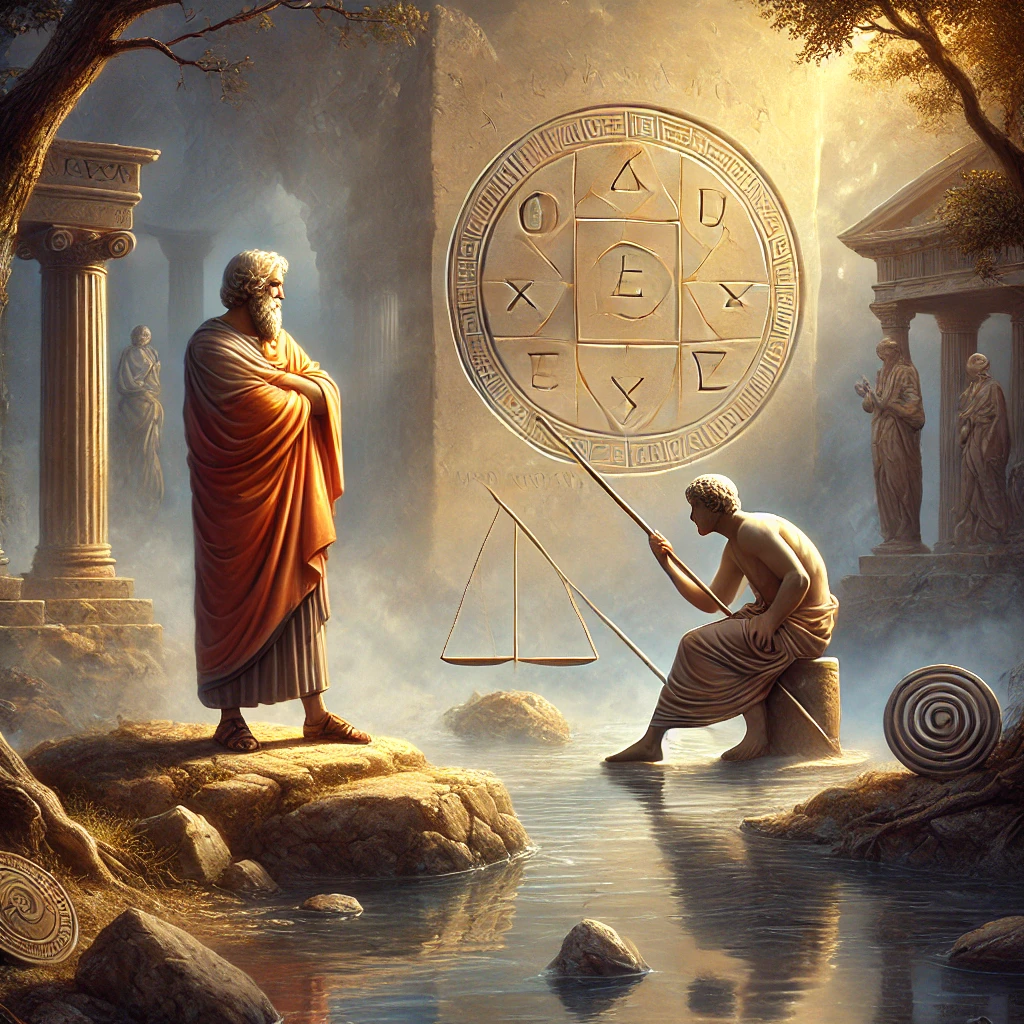
When Socrates was praised by the oracle for his unmatched wisdom, he humbly replied that his only knowledge was that he knew nothing. Despite his legendary status, Socrates acknowledged that man is not omniscient. Due to his rational nature, as Aristotle classified him, a man may be tempted to believe he is self-sufficient, relying solely on his reason. This belief could lead him to idolize his perceptions and disregard the possibility of transcending himself and reaching beyond his limited understanding. Plato’s concept of the World of Forms illustrates this limitation. Human perception, as he argued, is an imperfect reflection of a higher realm of perfect knowledge. Reconciling Aristotle’s notion of man’s rational superiority with Plato’s World of Forms reveals that while man is indeed superior, his knowledge is limited by his senses. For instance, a rod appears bent in water but is straight when removed, illustrating that our senses can mislead us. Thus, man must guard against becoming subservient to his sensory perceptions and instead aspire to seek the ultimate truth beyond them.
Conclusion
While it is uncommon to merge these concepts of man’s rational soul and the World of Forms, such a discussion illuminates the balance between human superiority and limitations about reality. Through this lens, philosophy can better appreciate human strengths, responsibilities, and weaknesses.